

The WHY & Pray Away Hangover
A not‑so‑serious survival guide to life after telling everyone your business.
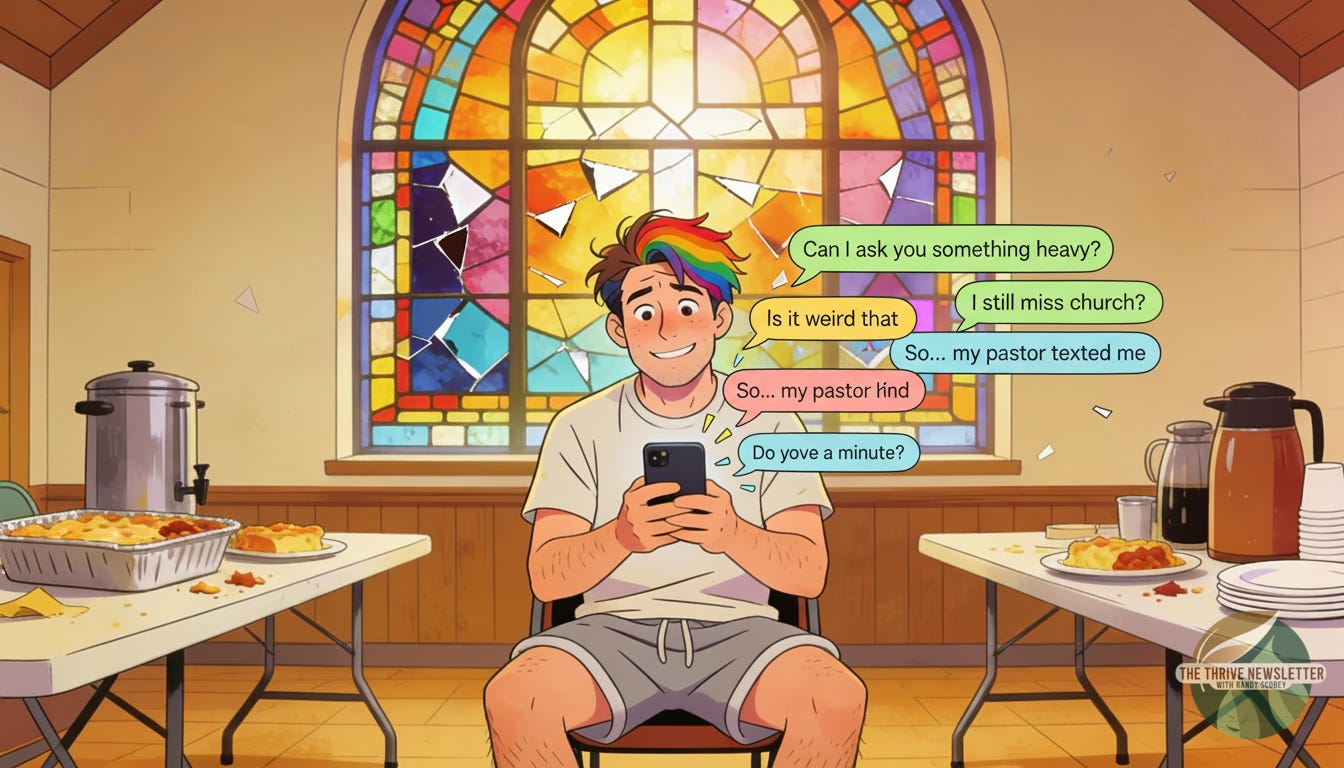
Welp, now what?
Life after WHY and Pray Away has felt a little like sitting in a church basement after the potluck, surrounded by half‑eaten casseroles and people who now know way too much about my childhood. I’m supposed to be ‘the author’ now—capital A, very Serious and Inspirational—but most days I’m just a gay man in his weekend shorts trying not to trauma‑bond with strangers in the Target parking lot. This is not the polished epilogue where everything is resolved and I’m bathed in holy backlighting. This is the part where I’m learning how to have boundaries, enjoy my own life, and still overshare on the internet—just… strategically.
That said, here are some tidbits I learned after releasing my memoir and being in the film Pray Away.
Do not become everyone’s trauma help desk
I am not a licensed professional counselor. I am not the son of a licensed professional counselor. I am not a life coach and actually detest the actions/advice coming from most (not all) claiming to be life coaches. I am not a church or community leader; I am just a former religious right conversion therapy leader who gained a smidge of infamy as such. I changed my mind after tragedy and wrote a book whose motive (at first) was simply to explain myself.
I was really fucked, up. Now I’m just a little fucked up in humorous ways.
In other words, I will give opinions, but when it comes to someone else’s healing, I will be there bouncing around with pom-poms, my hair in a ponytail, cheering you on as you read my memoir while waiting in the lobby for a real professional counselor to help you out.
Remember you’re a person, not a plot twist
Every once in a while, to my great surprise (truly), some random stranger will stop and say, “I know you… where do I know you from?” Dan almost always immediately says, “He’s been on Netflix and wrote a book!”
Thanks, Dan :::rolleyes:::
When it dawns on them and they make the connection, it usually leads to a good conversation and a new friend. Yet it ALWAYS catches me off guard and, truth be told, an instant fear settles in that makes me want to go home, pull out some snacks, watch Real Housewives of Beverly Hills, and pet my chihuahua while he tries to gnaw off my thumb.
I don’t want to be a villain in someone’s memory of a traumatic time in their life. That kind of really not great conversation happened several times in the past ten years, but my inner self-hatred reminds me it still has a place by turning it into a constant fear that really shouldn’t be the focus of a potentially difficult conversation.
But when I back out of that spiral and remember I am the totality of my life experiences and not just one moment in them, I calm down and can lean into what almost always turns out to be a normal, good conversation. I’m getting better at that over time.
Roll around in the glitter, don’t be defined by the scar tissue
There’s a difference between honoring what hurt us and auditioning for the role of “forever wounded.” At some point, we realize we’re allowed to roll around in the glitter of our life—the joy, the sex, the shameless laughter—without issuing a disclaimer about our scar tissue every five minutes.
The professional wounded, over time, become exasperating.
The scars are real; they tell us where we’ve been and what we survived, but they don’t get to be our job title, our whole brand, or our only way of connecting to other people.
I don’t want to be “the trauma guy” at the proverbial potluck; I want to be the one double‑fisting cheesy potatoes and stories about the ridiculousness of being alive. So yes, I’ll acknowledge the wounds, but I’m choosing to be defined by the sparkle I cultivate on the other side of them, not by the places that once split open.
On choosing glitter over gloom at the end of the story
So if you’re here, reading this, you already know I’m not offering a neatly wrapped redemption arc so much as a slightly dented take-home container from the potluck. I’m still figuring out how to answer big, tender questions without turning myself into a walking open wound, how to tell the truth without re-enacting it for free. But if there’s a thesis, it’s this: we’re allowed to keep living loudly and weirdly and joyfully, even after we’ve told the hard stories. The scar tissue can come with us, sure—but the glitter gets the front seat.

More about Randy…

Good perspective. I tend to overshare my experiences. As a result I feel as though ive given away my power to these people. Lately, the only people I will share intensely with are counselors.
Im still pretty fucked up and single still. Im learning contentment as I learn to set new boundaries and network with healthier people who add to and not subtract my current contentment.